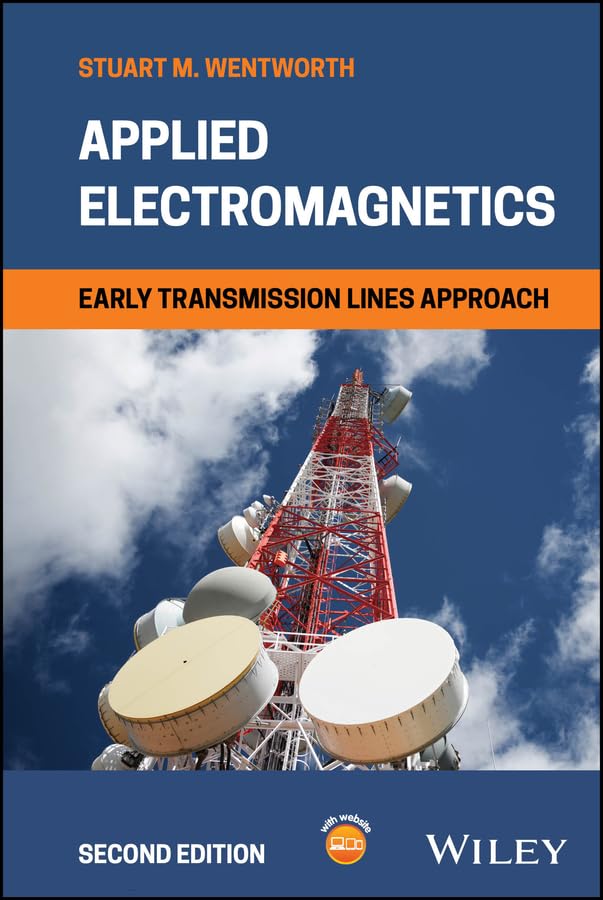
Stuart M. Wentworth
Applied Electromagnetics
Applied Electromagnetics
Couldn't load pickup availability
ELECTROMAGNETICS FOR A WIRELESS WORLD
The revolution in wireless communications calls for a new focus in the electrical engineering curriculum. Stuart M. Wentworth pioneers this new approach with his new Applied Electromagnetics: Early Transmission Lines Approach. Incorporating the popular MATLAB program throughout, this book starts you off with a rock-solid foundation on such basics as static electric and magnetic fields, dynamic fields, and plane waves. It then prepares you for the new wireless world with a concerted focus on practical applications for wireless systems, transmission lines, waveguides (including optical fiber), antennas, and microwave systems.
Numerous worked out examples, drill problems, and end-of-chapter problems will clarify your understanding of electromagnetics, and the many MATLAB examples and problems will ensure your mastery of the information. Intelligently designed and feature-packed, Wentworth's Applied Electromagnetics offers a rare marriage of detailed theoretical grounding and hands-on experience in harmony with today's professional practice.
STUDENT COMPANION SITE
Every new copy of Stuart Wentworth's Applied Electromagnetics comes with a registration code which allows access to the Student's Book Companion Site. On the Book Companion Site, the reader will find:
- Detailed Solutions to Odd-Numbered Problems in the text.
- Detailed Solutions to all Drill Problems from the text.
- MATLAB code for all the MATLAB examples in the text.
- Additional MATLAB demonstrations with code. This includes a Transmission Lines simulator created by the author.
- Weblinks to a vast array of resources for the engineering student.
Go to www.wiley.com/college/wentworth to link to Applied Electromagnetics and the Student Companion Site.
ABOUT THE PHOTO
Passive RFID systems, consisting of readers and tags, are expected to replace barcodes as the primary means of identification, inventory, and billing of everyday items. The tags typically consist of an RFID chip placed on a flexible film containing a planar antenna. The antenna captures radiation from the reader's signal to power the tag electronics, which then responds to the reader's query. The PENI Tag (Product Emitting Numbering Identification Tag) shown, developed by the University of Pittsburgh in a team led by Professor Marlin H. Mickle, integrates the antenna with the rest of the tag electronics. RFID systems involve many electromagnetics concepts, including antennas, radiation, transmission lines, and microwave circuit components. (Photo courtesy of Marlin H. Mickle)
Share